For this family of four, the journey begins at Touda, in the heart of the Aït Bougmez valley. A few days to explore the valley and its Amazigh villages, before climbing higher and setting off on foot towards the Izourar plateau and the M'Goun gorges.
Then, after the trek, the road continues south: the Valley of Roses, the Dadès gorges, the Skoura palm grove and finally Aït Ben Haddou.
A journey in several stages, combining hiking, mountains, encounters and the discovery of southern Morocco.
A few days at Touda before heading into the mountains
Before setting off on foot, the family settles in at Touda ecolodge, in the Aït Bougmez valley.
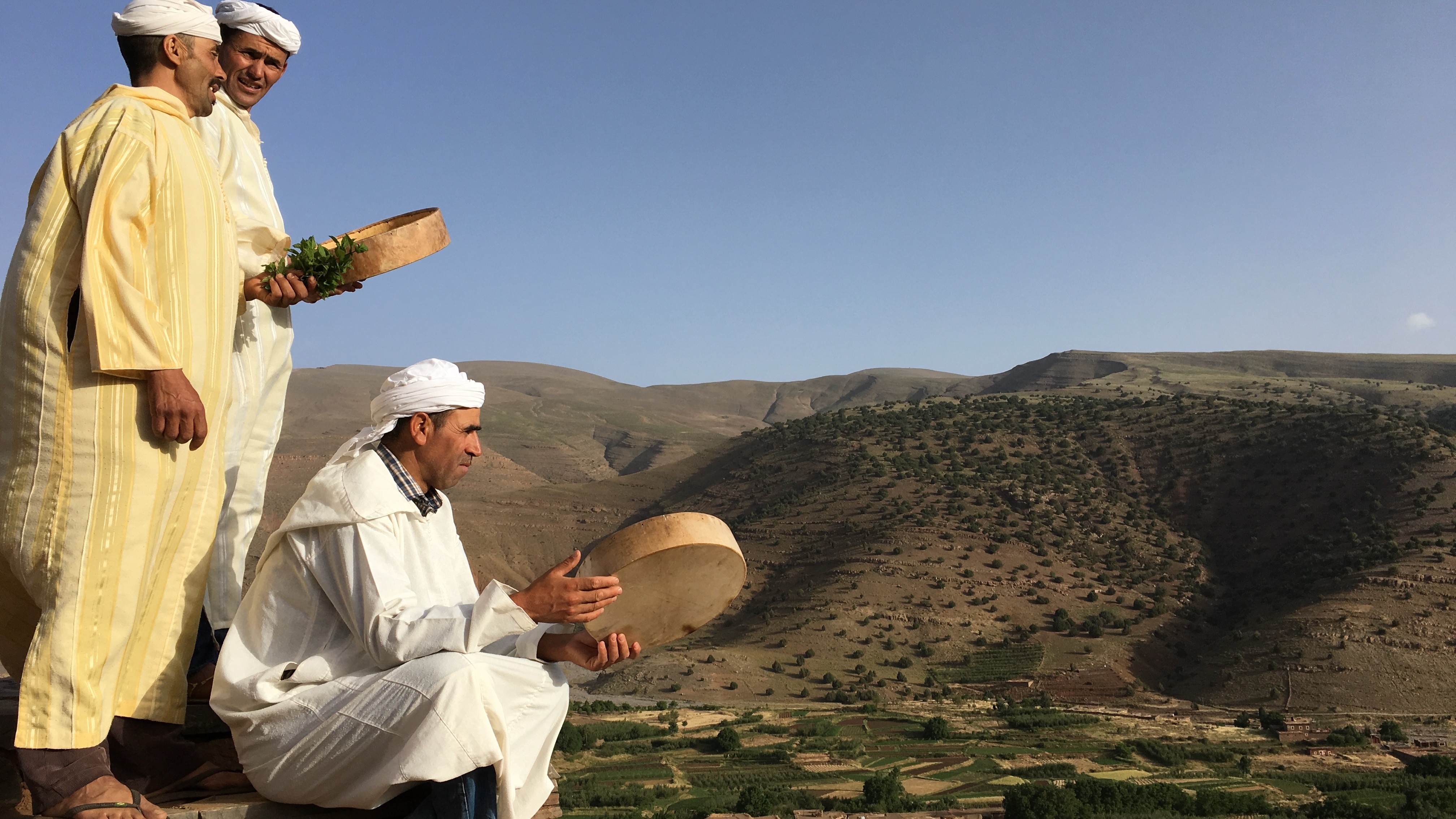
Here, the journey starts gently. You discover cultivated fields, earthen villages and the paths linking the valley's many hamlets. Water, precious in these mountains, has shaped the lives of the inhabitants and their crops for generations.
These first days are also a chance to settle into the rhythm of the High Atlas. You walk without rushing, take in the landscapes and discover an Amazigh culture that is still very much part of daily life.
This is what makes a stay at Touda special: the trek does not necessarily begin on the first morning with a pack on your back. It begins with getting to know the valley.
From the Aït Bougmez valley to the Izourar plateau
Then comes the time to set off.
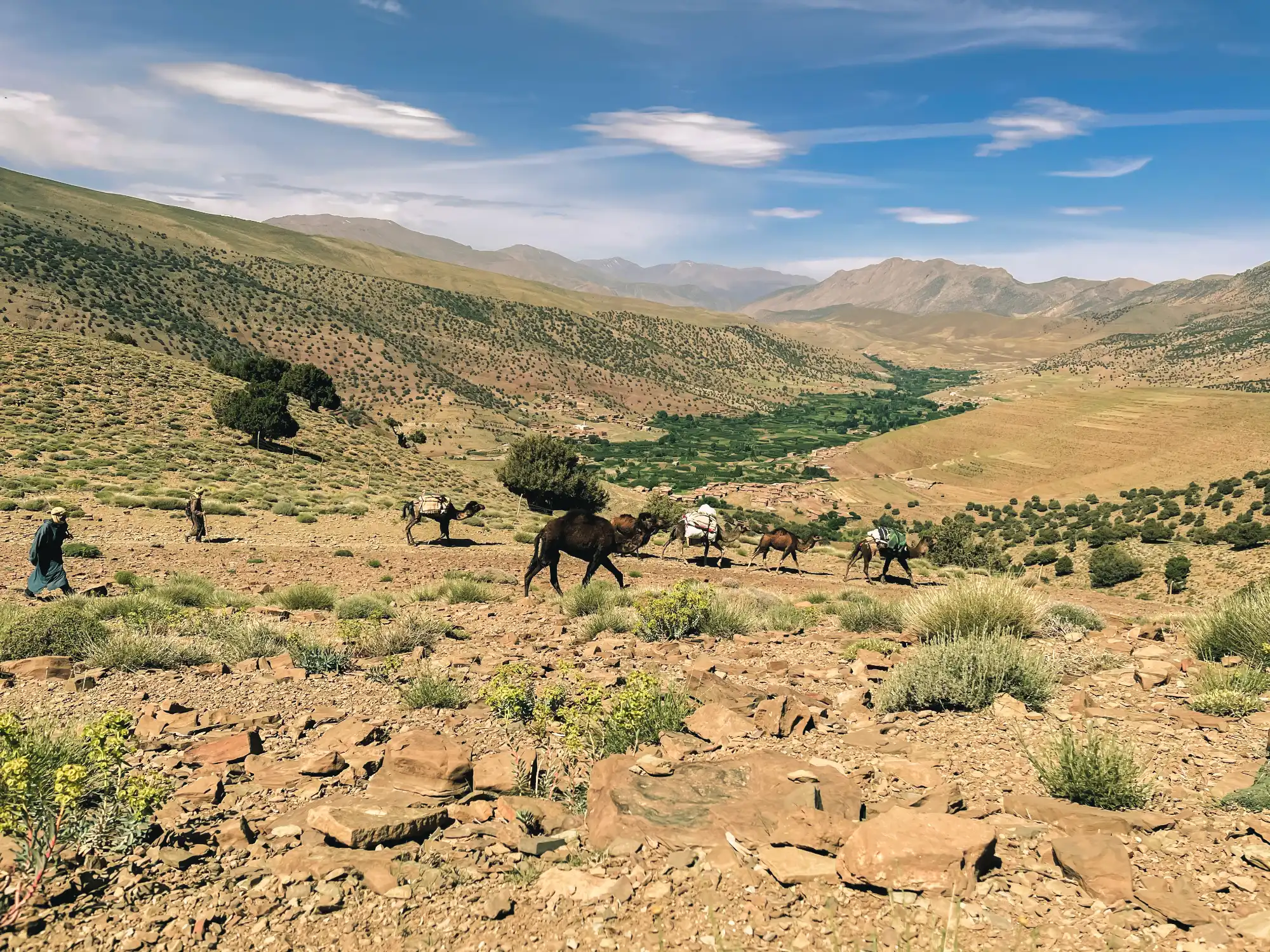
As you leave the valley, the landscape gradually changes. The green ribbon of the valley and its villages give way to wilder terrain. The trail climbs towards the Izourar plateau and its lake, into far more mineral mountains.
You start to feel the altitude, and the surroundings change completely.
For a family, this progression is especially rewarding: everyone gradually finds their own pace. Walking becomes a shared adventure, with its moments of fatigue but also that special satisfaction you feel when you reach a pass or discover a new landscape.
The High Atlas then reveals another side of itself: more austere, more vast, almost desert-like in places.
A team that turns a trek into a real journey
On a multi-day trek, the landscape matters a great deal. But the people who travel with you matter just as much.
The guide
The family is accompanied by a professional guide who knows the mountains and the trails of the Atlas inside out. His role goes far beyond showing the way.
He shares his knowledge of the landscapes, the villages, mountain life and Amazigh culture. He also knows how to adjust the pace, offer encouragement when tiredness sets in and, above all, bring that touch of good humour that changes the whole mood of a day on the trail.
Hour after hour, kilometre after kilometre, bonds form naturally.
In the evening, once the boots are off and the tent is up, the mountain shows another face. Everyone gathers around a meal, talks about the day, tells stories... and sometimes a card game starts up in the tent.
The guide then becomes much more than an escort: he becomes a full part of the story of the trip.
The cook
Alongside him, a cook travels with the trek. While the walkers explore the mountains, he prepares the meals waiting for the group at the end of each stage.
Simple, generous, comforting dishes, cooked just like at home.
After several hours of walking, sitting down to a good hot meal at the bivouac is no small thing. It is a real pleasure, and often one of the most anticipated moments of the day.
The muleteers and their mules
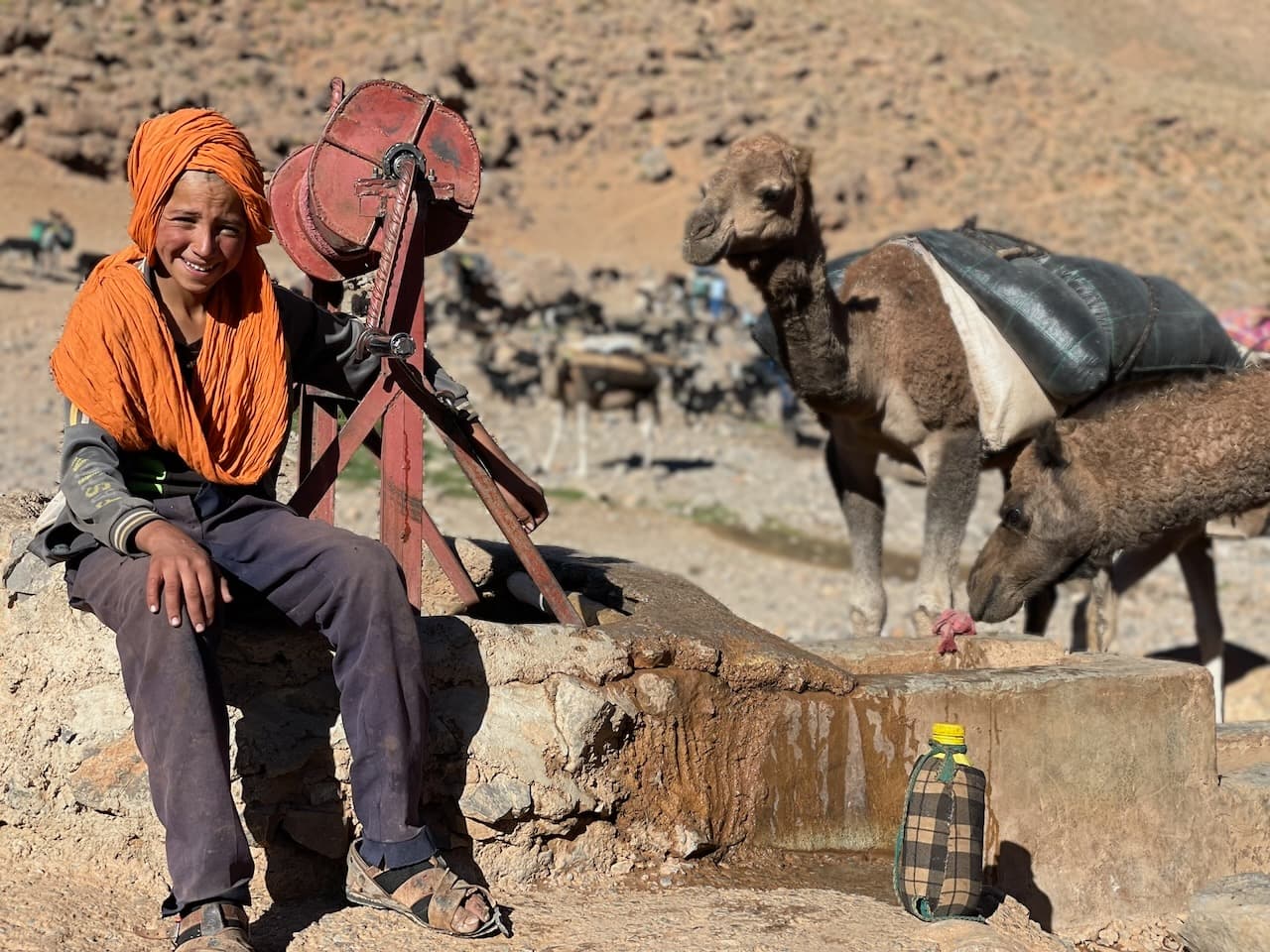
Finally, there are the mules and muleteers, essential to this kind of journey. The mules carry the luggage, the camping gear and everything needed for life at camp.
This way, everyone walks with a light daypack and can focus on what matters: enjoying the trail and the scenery.
A comfortable bivouac, like a home that moves every day
In the evening, another side of the trek begins.
After a day on foot, the group reaches its tented camp, set up in a new setting. Here, bivouac does not mean giving up comfort. The tents are arranged so you can recover properly after walking, in a warm and friendly atmosphere.
The next morning, you pack up and set off again.
Then, as evening falls, a new tent appears somewhere else, in another landscape.
It is a little as if your home were travelling with you, changing location every day.
This way of walking brings a special sense of freedom. No need to return to the same place after each hike: you keep moving, cross the mountains, fall asleep in the middle of nature and wake up to a different view.
For children, this can become one of the strongest memories of the trip. The bivouac gives the trek a taste of adventure, while keeping the comfort needed to fully enjoy the days of walking.
And comfort does not come from the tent alone.
It also comes from the quiet, invisible organisation that lets the group walk light, find a camp already set up each evening, enjoy a good meal and share a convivial moment.
The trek then becomes a far gentler experience than you might imagine.
Crossing a pass above 3,000 metres
One of the highlights of the trek is crossing a pass at more than 3,000 metres above sea level.
At this height, the mountain naturally sets the pace. The terrain is more demanding, the air cooler and the scenery becomes spectacular.
But a family trek is not a race.
The whole point of a guided itinerary is being able to adapt the pace to the group, take the time needed and enjoy the trail rather than simply trying to reach the next stage.
In these mountains, distance tells only part of the story. It is the altitude, the terrain and the elevation gain that really determine how hard a day will be.
And when you reach the pass, the reward is there: a vast landscape opens up before you, with that very particular feeling of having truly crossed the mountain.
The M'Goun gorges: the highlight of the trek
After the high plateaus and the high-altitude passages, the scenery changes again as you enter the M'Goun gorges.
The river has carved its way through the rock, and the trail gradually leads into a much narrower world. The walls close in, the light changes and the water becomes the guiding thread of the hike.
Crossing the gorges is one of the great moments of any trek in this region.
You move at the river's pace, sometimes walking in the water depending on conditions, between walls sculpted by erosion. After the open spaces of the Izourar plateau, this immersion in the gorges almost feels like entering another world.
For children and adults alike, this is what makes the experience so memorable: the trail becomes an adventure to share, rather than just a hike.
And in the evening, the bivouac is waiting somewhere further along the route. A new tent, a new landscape, a new evening.
Two families setting off together
As the days go by, something special takes shape.
At the start, there is a family who came to discover the High Atlas and a Moroccan team there to accompany them.
But after several days of walking, the line between "travellers" and "team" matters less and less.
You walk together. You share meals. You joke. You play cards in the tent. You help each other on the trickier sections. You gather around the bivouac every evening.
In the end, it is hardly a group of travellers and a team moving forward together anymore: it is two families going on a trek.
Perhaps that, deep down, is what makes the difference between an organised hike and a real journey.
After the trek, hitting the road to southern Morocco
The trek may be over, but the journey does not end there.
For three days, the family continues exploring southern Morocco with a driver and a guide. After several days on foot, the rhythm changes: you are back on the road, but the landscapes keep changing.
- The Valley of Roses, famous for its rose fields and its rose-growing know-how.
- The Dadès gorges, where the road winds through cliffs, valleys and rock formations in ever-changing colours.
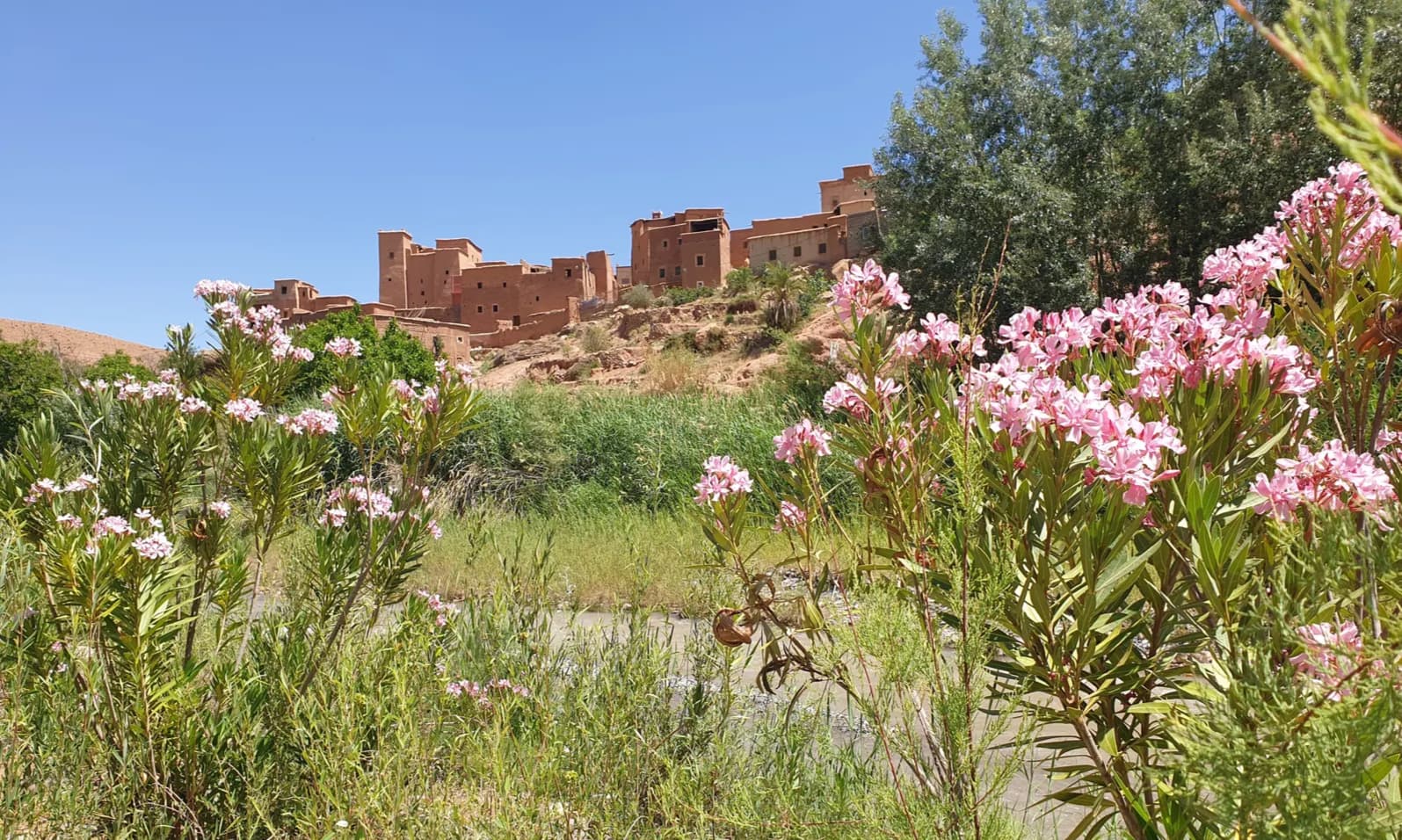
- The Skoura palm grove, a striking contrast with the mineral landscapes crossed earlier. Gardens, crops and old kasbahs hide among the palm trees.
- Aït Ben Haddou, one of the most iconic ksour of southern Morocco and a UNESCO World Heritage Site.
A final stop that is a reminder that Morocco can never be summed up by a single landscape.
The High Atlas as a family: an adventure built along the way
This trip shows that a family trek in the High Atlas can be much more than a series of walking days.
First there is the Aït Bougmez valley and village life. Then the mountains, the altitude and the wide open spaces of the Izourar plateau. Next come the M'Goun gorges, before returning to the road and the landscapes of southern Morocco.
And there is that freedom unique to trekking: every morning you leave your bivouac for a new horizon; every evening you return to a tent that has become familiar, but never in the same place.
This freedom is made possible by a whole team: the guide who leads and shares, the cook who prepares the meals, the muleteers who look after the luggage and the mules that let the group walk light.
Together, they create the conditions for the family to simply enjoy their trip.
For a family, good support is essential. A well-suited itinerary, carefully chosen stages and a team that knows the mountains let you make the most of the experience, without turning the trip into a sporting challenge.
Because the goal is not just to go far.
It is to experience something together.
Another way to discover Morocco
From Touda, the High Atlas is explored on foot, at the pace of the mountains and the people you meet.
Hiking then becomes a gateway to a more intimate Morocco: one of valleys, Amazigh villages, mountain trails and landscapes that change at every stage.
The bivouac extends this feeling of freedom. You walk during the day, set up your home for the night in the heart of the mountains, then move on the next morning.
A home with a new view every day.
And behind this freedom are the women and men who make the experience possible: a guide, a cook, muleteers and their mules. A team that, day after day, becomes an integral part of the journey.
When the trek ends, the road to the Valley of Roses, the Dadès, Skoura and Aït Ben Haddou naturally extends the adventure.
But the strongest memories may be the ones that appear on no map: laughter shared in a tent, a card game after a long day on the trail, a hot meal in the middle of the mountains, or simply the feeling of having moved forward together.
Would you like to discover the High Atlas as a family?
Touda offers guided stays and treks in the High Atlas, tailored to the pace and wishes of each group, with a dedicated local team to make trekking an experience that is authentic, comfortable and deeply human.
Auteur
Saïd Marghadi
Publié le
September 15, 2026
Partager